How Delta Exchange Offers a Seamless Crypto Derivatives Trading Experience for Newcomers

At first glance, crypto derivatives like futures and options can sound overwhelming. But with the right tools and a user-friendly approach, even complete newcomers can navigate this space with confidence. In this post, we’ll discuss how Delta Exchange, a leading cryptocurrency exchange, delivers a seamless experience for anyone new to crypto derivatives.

Why Crypto Derivatives and Why Delta?

India’s appetite for crypto trading has grown exponentially since the COVID-19 pandemic. In 2024, India recorded over 90 million users, making it the global leader in crypto adoption. 

Crypto derivatives, including futures and options, let traders benefit from the price movements of assets like BTC and ETH without needing to directly own them. Think of futures as agreements to buy or sell an asset at a future date at a set price, and options as having the right, but not the obligation, to do so within a certain timeframe. 

For those who want more flexibility and don’t mind a bit of risk, these instruments open the door to advanced trading strategies, hedging, and profit-making in both rising and falling markets.

What sets Delta Exchange apart?
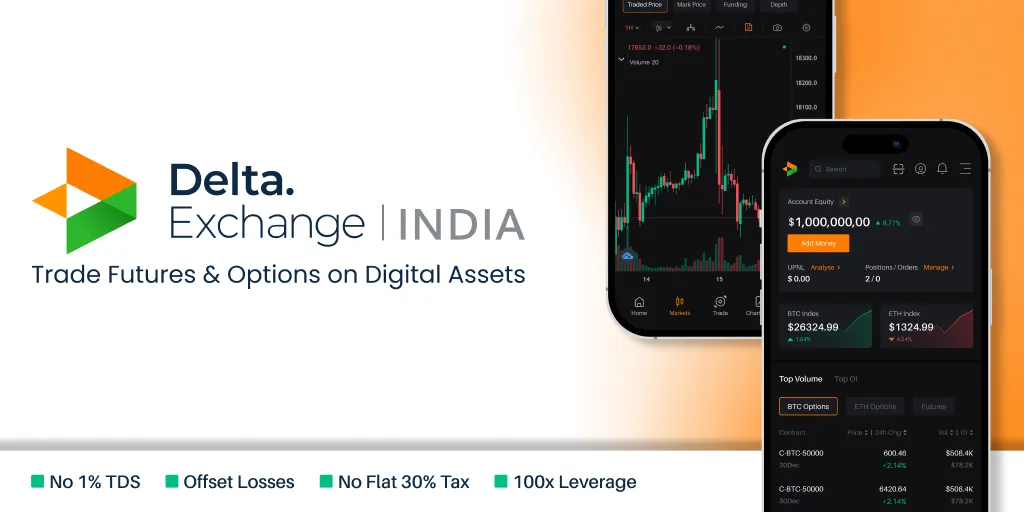
Trade crypto futures and options on BTC, ETH, and more

Instead of asking Indian users to convert Rupees into USDT, USDC, or another stablecoin, Delta allows direct INR settlements. This streamlines the process, spares users from unwanted forex conversion charges, and makes tracking profits (and taxes) more straightforward than ever.

The INR Advantage: Trade in Your Own Currency

Delta’s INR-settled trading is a huge plus point for a few key reasons:

  • No more headaches over fluctuating exchange rates eating into your profits.
  • Capital gains are easier to calculate in INR, sidestepping complex tax scenarios.
  • New traders don’t need multiple wallets or extra steps to get started – everything runs natively in your home currency.
  • Withdrawals are direct and instant into local bank accounts, without hidden deductions.

For Indian traders, this INR-first approach removes a ton of friction and “what-if” worries, leaving more time to actually focus on the markets.

Lower Barriers: Start with Small Lots

Delta Exchange gets that new traders often want to get a feel for the market without risking large sums. That’s why they allow starting trades with as little as ₹5,000 for BTC contracts and around ₹2,500 for ETH. Whether testing a strategy or learning the basics, there’s no pressure to go all-in from day one. 

This approach encourages measured, sustainable growth and empowers more people to try out crypto derivatives trading.

User-Centric Features That Actually Help

Walking into the world of crypto derivatives shouldn’t feel like you’re learning a different language. Delta Exchange makes every feature, tool, and button as approachable as possible:

  • Trading bots: Not sure when to buy or sell? Let the automated bots do the work, following strategies you set (or community templates) so you aren’t glued to your screen.
  • Strategy builder and basket orders: Build, test, and execute complex trades in just a few clicks – and see a payoff chart before committing any real money.
  • Leverage: You can amplify your exposure with leverage, trading up to 100x your starting capital. Perfect for seasoned traders, but there’s no pressure – start small and increase leverage only when you’re comfortable.
  • Demo account: The free demo account is perfect for stress-free practice. Test features, fiddle with strategies, and learn the ropes without risking a single rupee.

Mobile App: Crypto Trading From Anywhere

Delta Exchange’s crypto trading app brings the entire experience to your phone (both iOS and Android) or tablet, so you can trade, manage, and monitor your positions at any time This gives new and experienced traders alike the freedom to spot opportunities and react quickly, even on the go.

Compliance, Safety, and Trust

Safety is a top concern for every user, but even more so for newcomers. Delta Exchange is registered with India’s Financial Intelligence Unit (FIU-IND). This means the platform operates within regulatory guidelines and prioritizes compliance at every step, giving you peace of mind that your funds are handled securely and your account is on the right side of the law.

Deep Liquidity and Fast Execution

Worried you might not find buyers or sellers when you want to trade? Delta’s robust ecosystem regularly handles billions in daily trading volume. This means your trades are executed quickly at market prices, not delayed or subject to wild slippage. 

For new traders, that means fairer, smoother trades and less anxiety about “getting stuck” in unwanted positions.

Broad Asset Choice – Without the Learning Curve

Delta Exchange covers all the big cryptos – BTC, ETH, SOL, and several altcoins – allowing traders to diversify and experiment with multiple assets, not just save everything for Bitcoin. Crypto trackers mimic spot trading but in a derivatives environment, making newcomers’ first steps gentler and less risky.

Check out this video to learn more about the best time to trade crypto derivatives for maximum profits:
https://www.youtube.com/watch?v=B_1zMLMvdRA

Getting Started
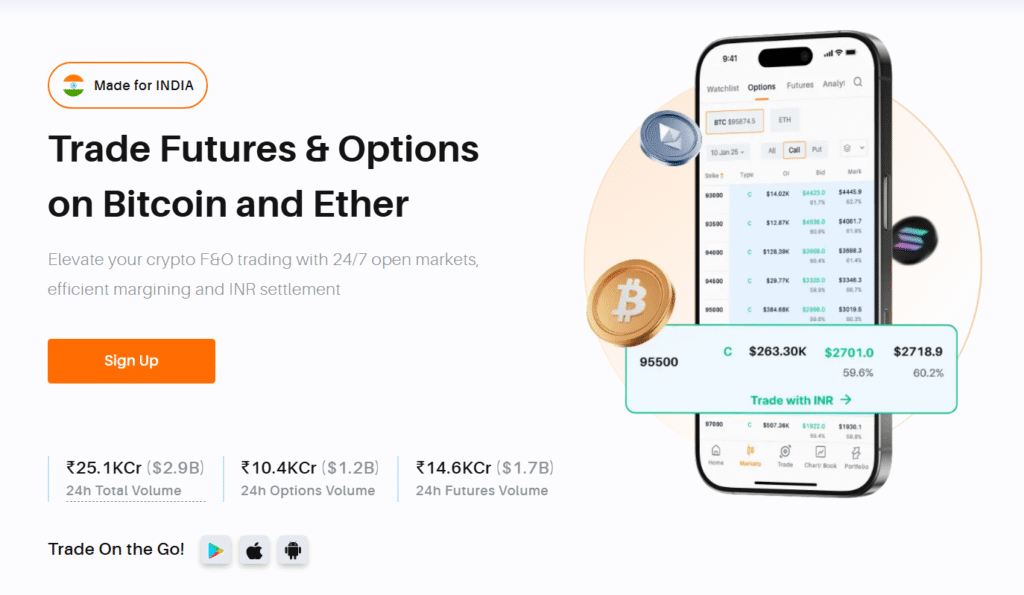
Trade BTC and other altcoins smoothly

Jumping in is easy and intuitive:

  1. Sign up on Delta Exchange with your email or phone.
  2. Deposit INR through supported payment methods.
  3. Browse and choose between crypto futures, options, or trackers.
  4. Use the app or website’s built-in tools for setup, order placement, and trade management.
  5. Withdraw profits directly to your bank, no conversions or intermediary steps.

Final Thoughts: Is Delta Right for Newcomers?

With its focus on INR-settled trading, approachable lot sizes, solid compliance, powerful automation and algo trading bots, Delta Exchange gives new traders the best shot at building confidence – without the stresses of global conversion fees, complex tax headaches, or steep learning curves. Whether you’re dipping your toe into crypto derivatives for the first time or looking for features that scale as you grow, Delta Exchange supports every step, every trade, every question.

Crypto trading carries its risks, as always, but with platforms like Delta Exchange smoothing out the bumps, getting started has never been easier or more secure. This is how seamless, user-friendly, and empowering crypto derivatives should feel for every newcomer entering the market.

To start trading crypto derivatives, visit www.delta.exchange  or join the community on X for the latest updates. 

Disclaimer: Investing in cryptocurrency carries a high risk of market volatility. Kindly do your own research before investing.

Are Memecoins Dead? Top 5 Memecoins to Make Millionaires, Best Memecoins to Invest in November 2025 Previous post Are Memecoins Dead? Top 5 Memecoins to Make Millionaires, Best Memecoins to Invest in November 2025
Asia’s crypto media doesn’t move in a straight line. It surges, stalls, reorganizes, and then returns sharper, reshaped by the way people actually read, search, and share information. In Q2 2025, that pattern became clearer than ever: South Korea and Japan together drew more than 70% of all crypto-native media visits in Asia, giving them unmatched influence over the region’s rhythm and narrative direction. Outset Data Pulse, a continuous intelligence framework by Outset PR that uses Similarweb data, on-the-ground surveys, and PR-native metrics, has already mapped crypto media shifts across Eastern Europe and Latin America between April and June. These regions faced different pressures, but Asia stood out for how strongly loyalty shaped the market. Returning readers became the engine that pushed outlets ahead. The following sections unpack how Asia’s crypto news ecosystem actually works: by region, by habit, by trust, and increasingly, by how machines interpret content. East Asia Leads Asian Crypto Outlets East Asia is the continent’s media anchor. South Korea’s 57 million visits and Japan’s 11.7 million place the region firmly at the center of Asia’s crypto information flow. Image sourced from Outset PR Korea’s biggest outlets Coinpan, Coin Readers, BlockMedia, and TokenPost have become part of readers’ daily routines. They’ve grown from being just news sites to information hubs deeply integrated into how markets move. Japan mirrors this structure but with a different tempo: rapid updates, real-time commentary, and constant visibility on X, where CoinPost maintains one of the strongest live-news presences anywhere in Asia. “East Asia has built something rare in today’s media world,” says Maximilian Fondé, senior media analyst at Outset PR. “Readers return to these outlets out of habit, the same way you go back to a café where they know your order. They know the tone, they know the context, and they feel understood. That everyday connection is what gives the region’s media its strength.” Outset Data Pulse refined composite score and engagement index reinforce this picture. These metrics show not only who attracts the largest audience, but who keeps readers engaged, rewarding outlets that combine scale with loyalty and structured reporting. This contrasts sharply with Eastern Europe, where search volatility wiped out visibility for more than half of crypto outlets earlier this year. East Asia’s stability comes from something algorithm updates can't replicate: audiences who already know where they want to go. One exception in the data is CoinPan, which posted some of the strongest engagement signals but fell out of the top-tier ranking due to a traffic dip in Q2. Under Outset PR’s methodology, consistency matters as much as depth; strong engagement alone isn’t enough to stay in the top group. Southeast Asia’s Crypto Publishers Grow Faster If East Asia is the anchor, Southeast Asia is the growth engine. Across Indonesia, Vietnam, and Thailand, the combined traffic clears 12 million visits, and with Malaysia and Singapore’s smaller but loyal communities added in, this part of Asia may be smaller than Korea on paper, but it’s growing at a much faster pace. Here, crypto media doesn’t rely on a single channel. It thrives on a blend of newsroom-style platforms, creator ecosystems, Telegram groups, and bilingual local formats. Image sourced from Outset PR Indonesian outlets like CoinEdition push hard into structured data and multilingual SEO, making their content highly discoverable. Vietnam’s crypto media relies on community-driven distribution, where native-language posts spread through Facebook groups faster than traditional news cycles. “Readers in Southeast Asia want speed, but they also want identity,” Fondé says. “They want to hear from someone who understands their local reality.” This is one reason the March 2025 Google update, which decimated Western Europe’s crypto visibility, barely impacted Southeast Asia. Audiences here never relied solely on search in the first place. Asian Crypto Audiences Return to the Same Outlets Across Asia, 54% of all crypto-native visits are direct. That means no search, no social push – just readers going straight to the source. This level of loyalty is extremely rare. In Latin America, direct traffic appeared only among a small group of top performers. In Western Europe, it collapsed almost entirely after algorithm changes. Asia is different: it operates on routine. Korea checks crypto news throughout the day. Japan uses X as a real-time wire service. Indonesia blends local newsrooms with creator-led discussions. Vietnam follows trusted native-language sources and regional groups. Image sourced from Outset PR “Direct traffic is the strongest signal of trust,” Fondé says. “If more than half of readers go straight to crypto-native sites, it means they’ve already chosen where they want to be.” This loyalty makes Asia’s media ecosystem remarkably stable. When sentiment dips globally, Asian audiences don’t scatter but stay anchored to familiar outlets. Emerging Markets Across South and Central Asia Beyond East and Southeast Asia, South and Central Asia present a quieter but steady growth curve. These markets aren’t large individually, but they build readership through consistency, education, and clear editorial structure. Taiwan and Hong Kong balance local and cross-border audiences with bilingual coverage. Malaysia, Singapore, and the Philippines maintain smaller ecosystems yet show reliable reader engagement month after month. These regions resemble the early stage of the LATAM ecosystem: small but structurally improving, with a growing emphasis on transparency and reader education, especially around RWA tokenization, AI-integrated chains, and early-stage regulation. Regulation Makes Crypto Media Stronger in East Asia Than in Other Asian Regions Japan and South Korea operate under some of the clearest crypto media and advertising guidelines in the world. Outlets must frame investment-related content responsibly, maintain high accuracy, and avoid exaggerated claims. This results in consistently higher trust and stronger long-term visibility. In Southeast Asia, where regulation is softer, self-governance plays a similar role. Editors in Vietnam, Thailand, and Indonesia emphasize clear labeling of sponsored content, rapid corrections, and cultural transparency. They maintain credibility because their readers demand it. “It’s two different paths to the same goal,” Fondé says. “Formal rules drive trust in East Asia, while reputation drives trust in Southeast Asia.” Western Europe’s hyper-regulated MiCA environment showed what happens when compliance becomes too rigid: visibility shrinks. Asia’s balance – part regulation, part culture – allows credibility without suffocating the media layer. AI and Local Languages Impact How Asians Find Crypto News AI discovery is small but rising, almost 0.6% of all crypto-native traffic, and the distribution is uneven. China’s 528BTC already gets over a quarter of its referrals from AI engines. Indonesia’s CoinEdition shows similar patterns. Japan and Korea are catching up as their structured content improves. Language plays a defining role here. Mandarin, Korean, Japanese, Thai, Vietnamese, and Bahasa Indonesia each require different approaches to metadata, formatting, and headline structure for LLMs to understand the content clearly. “AI rewards structure more than style,” Fondé explains. “If content is clean, consistent, and machine-readable, it climbs, no matter the language.” This gives Asia an advantage over regions like Eastern Europe, where diverse languages often break metadata consistency and fragment visibility. Social Platforms Shape Crypto Engagement Differently Across Asia’s Regions Social media drives just under 5% of traffic but shapes nearly all conversation, and every region leans on a different platform: X dominates in Japan, Korea, and Hong Kong. YouTube fuels long-form crypto learning in Indonesia and South Korea. Facebook remains essential in Vietnam and Thailand. LinkedIn attracts professionals in Korea and Indonesia. Telegram remains strong in community-led markets. These platforms feed into both search and AI signals, influencing visibility far beyond their raw traffic numbers. Small Crypto News Sites in Asia Stay Visible with Niche Crypto Content Asia has 83 smaller crypto outlets, each with under 130,000 monthly visits. Together, they generate about 6% of all traffic, but their influence exceeds their size. These outlets focus on niche topics: AI tokens, DeFi mechanics, regional regulation, early-stage ecosystems. They win by being precise, consistent, and structured. “The smaller teams that succeed don’t try to do everything,” Fondé says. “They do one thing well, and they format it well.” This mirrors Outset PR’s findings in Latin America, where niche outlets survived even after generalist platforms saw massive drops. Asia’s Crypto Media is Settling into a Clear Structure The differences between East, Southeast, and South/Central Asia matter, but they all point toward one simple truth: people trust the outlets that feel like home. In a space where algorithms change every few months, that kind of loyalty is what keeps the whole ecosystem steady. So, to pull everything together, here are the questions that really sum up how Asia’s regions shape the way people read and trust crypto news today: 1. How do regional differences change what people trust in Asian crypto media? East Asia trusts long-standing outlets that publish fast, clean, accurate updates. Southeast Asia leans on bilingual creators, Facebook groups, Telegram AMAs, and local-language explainers. South and Central Asia grow through simple consistency. Each part of the region has its own habits, but they all reward content that feels local and familiar. 2. Why does East Asia still dominate traffic even when Southeast Asia is growing faster? Because routine is powerful. Korea and Japan built strong news habits years ago, and readers there already know which sites they trust, and they return to them no matter what’s trending. Even when other regions move quickly, East Asia stays on top because its audience is anchored, not drifting. 3. What helps smaller and mid-tier outlets survive in a landscape dominated by a few giants? A clear focus. When the big outlets cover everything, the smaller teams stand out by covering one thing really well: a niche topic, a specific market, or a type of analysis. In Asia, being specialized isn’t a disadvantage; it’s the way smaller outlets hold onto loyal readers and grow at their own pace. “Asia’s crypto audience moves with a rhythm of its own. Korea treats crypto news like part of the daily routine, Southeast Asia thrives through creator communities and local groups, and South Asia builds momentum through steady, informed growth. What ties all of this together is a deep sense of connection. Readers return to outlets that speak their language, reflect their reality, and show up with consistency. That steady relationship between site and audience is what fuels the region’s entire media ecosystem.” Fondé wraps up his takes. Next post South Korea and Japan Get Over 70% of All Crypto-Native Media Visits in Asia, Setting the Region’s Tone and Tempo